
How to Get Court Records
Name the court and the record layer before you request anything. Kim Windle James's office keeps the clerk records for Superior, State, and Juvenile cases. Probate Court and Magistrate Court are separate. Each city municipal court keeps its own traffic and ordinance files. Georgia Courts E-Access sends State and Superior users to PeachCourt. The local clerk also runs a credential-based Icon Case Management route.
A tight request works best. Give one court, one case or a narrow date range, one document type, and one delivery format. Chattooga publishes no full fee, ID, turnaround, or mail schedule. Call the clerk before you send money or a paper request.
- Write the court name, case number if known, caption or party, filing year, and exact document sought.
- Try Georgia E-Access and PeachCourt for State or Superior records when an account route is appropriate.
- Call or visit the responsible clerk for a public copy, certified copy, or confirmation of the proper custodian.
- Use the Georgia Attorney General Open Records form when a public record is not available through the normal court route.
- Ask for a fee estimate, the preferred format, and the exemption or order if any portion is withheld.
Mail and fax remain worth asking about. The clerk's office publishes no separate copy-request address, fax protocol, email route, or drop-box schedule beyond its basic contact information, so phone first.
Chattooga Court Record Requests
The Georgia Attorney General request form gives you fields for the date and recipient. It also takes the recipient street address, fax, email, the records wanted, and the requester's own contact details. It has no payment field, no ID field, no delivery selector, and no turnaround promise. Address it to the office that actually holds the record. Never send it to a generic county mailbox.
For Superior, State, or Juvenile material, name Kim Windle James's office. Probate goes to Probate Court. A Magistrate case goes to the Magistrate office. A city ticket goes to the issuing city. State whether you want a plain, certified, or other official copy. Ask the office whether the request belongs in PeachCourt, at the counter, or by mail. You can also ask about the Open Records Act.
| Request detail | What to state | Why it matters |
|---|---|---|
| Custodian | Chattooga Superior, State, Juvenile, Probate, Magistrate, or city court | Different offices hold different dockets. |
| Record | Docket sheet, pleading, order, judgment, exhibit, or full file | Separates an index request from a document request. |
| Time span | Case number or narrow filing, event, or hearing date range | Helps the custodian search and estimate cost. |
| Format | Electronic, plain paper, certified, or another requested form | Certification and delivery may use different processes. |
Types of Court Records
A docket is the first layer, not the whole file. It can show the event history and point you toward a filing. The filing layer holds complaints, accusations, indictments, answers, motions, affidavits, returns, exhibits, and proposed orders. Deeper still sits the disposition layer. It carries judgments, sentences, dismissals, consent orders, and appeal or certiorari material.
- Index and docket entries, including case identity, dates, event text, and status.
- Pleadings, accusations, indictments, petitions, answers, motions, affidavits, and returns.
- Signed orders, judgments, sentences, dismissals, consent orders, and other disposition material.
- Calendar, trial-list, standing-order, interpreter, and specialty-court administrative material.
- Restricted, redacted, juvenile, adoption, protected-identifier, or sealed records governed by access limits.
The clerk's Forms page works as a directory of legal forms and related resources. It does not hold every filed case document, and it cannot replace a case search.
Chattooga Record Layers
Chattooga's record system shows why one search term can miss the file you need. Georgia E-Access routes State and Superior e-access to PeachCourt. The local clerk site offers a separate Icon login. Circuit calendars and standing orders serve as public scheduling and procedure sources. Probate, Magistrate, Juvenile, municipal, and federal systems all sit outside that main State/Superior route.
PeachCourt vendor material describes view and request controls for complaints, answers, motions, notices, orders, decrees, exhibits, and transcripts. It also warns that some material can be sealed, restricted, missing, or unavailable. When an account gate blocks access, a document is simply not viewable. That is all you can honestly say about it.
The Georgia Superior Court Clerks directory supplies the clerk context. The E-Access directory marks the right route into the county's main e-access layer.
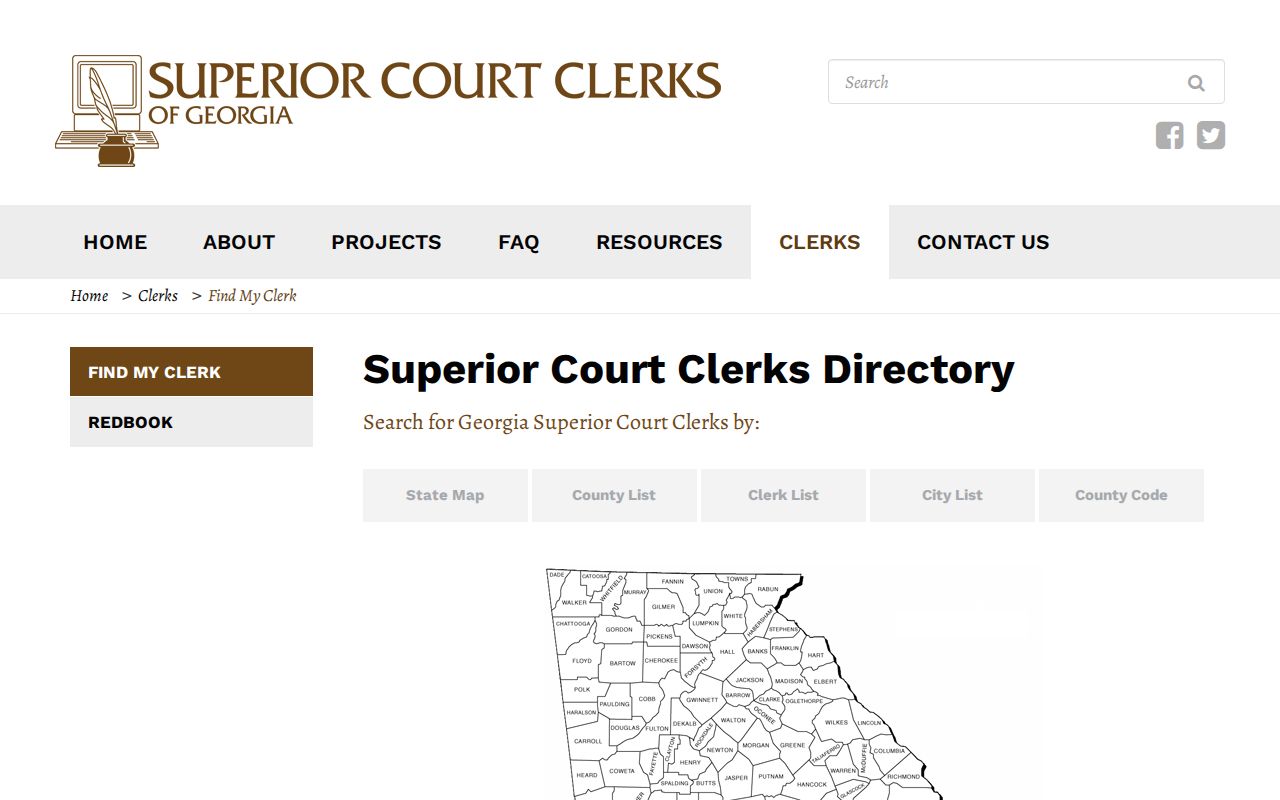
The Georgia Superior Court Clerks directory helps you confirm the state court-clerk context. For the county itself, the local Chattooga office remains the records contact.
What a Court Record Contains
What a court record contains depends on the case type and the document. A docket entry can identify a filing without showing its text. A full file adds pleadings, exhibits, service returns, orders, and a final judgment. A civil or domestic file may also hold protected pages. The field list below therefore stays at the document-type level. Each document answers only for itself.
| Case identity | Court, case number, filing date, case type, and caption when public. |
|---|---|
| Docket sheet | Chronological entries for filings, notices, settings, motions, orders, and status events. |
| Pleadings | Complaint, petition, accusation, indictment, answer, motion, affidavit, return, or response. |
| Orders and judgments | Signed rulings, final judgments, sentences, dismissals, consent orders, or appellate events. |
| Exhibits | Attachments filed with a pleading or offered in a hearing, subject to lawful redaction. |
| Access status | View, request, sealed, restricted, redacted, unavailable, or not-yet-observed control. |
Ask for the exact layer rather than just "the court record." That phrase could mean the docket, a certified judgment, a plain copy, a transcript, or the complete file.
Chattooga Clerk Records Desk
The official Chattooga Clerk site names Kim Windle James as the current clerk. The office handles Superior, State, and Juvenile records and publishes 10035 Commerce Street, Summerville, Georgia 30747, phone 706-857-0706, and fax 706-857-0686. The official pages post no records-window hours, public-terminal location, copy fee, ID rule, or turnaround, so ask the desk directly.
Kim Windle James, Clerk of Superior Court
Superior, State, and Juvenile records
10035 Commerce Street
Summerville, GA 30747
706-857-0706
Magistrate Court sits at 120 Cox Street, Suite C, phone 706-857-0711. Its weekday hours run 9 a.m. to 5 p.m. Probate publishes 8:30 a.m. to 5 p.m. The shared Commerce Street address does not merge these offices' files.
Certified Copies and Fees
A plain copy just reproduces the page. A certified copy is different. The clerk attaches a statement that it matches the official record on file, so tell the office which version you need. Chattooga publishes no itemized fee schedule, no certification charge, and no posted search or mail fee, and it names no accepted payment method or turnaround. Call the office before you order.
| Item | Amount or status |
|---|---|
| Chattooga clerk plain-copy fee | Not published in the inspected official sources; verify with the custodian. |
| Chattooga certified-copy fee | Not published; ask which certification process applies. |
| PeachCourt e-access or document fee | $2 in vendor terms inspected; verify current amount. |
| PeachCourt document pages | $0.50 per page in vendor terms inspected; verify current amount. |
| PeachCourt payment convenience charge | 3.5% plus $0.30 in vendor terms inspected; vendor amount can change. |
PeachCourt's figures are vendor charges. They are not the certified-copy fees set by the Chattooga clerk. The vendor terms say a receipt arrives by email within two business days. Before you pay, ask whether the record is free to inspect, priced per page, or carries a separate request or certification fee.
Chattooga Copy Fees Not Published
A missing fee table is not an invitation to guess. The county clerk, Probate Court, Magistrate Court, and the city courts can each handle copies differently. A vendor document fee is not the price of a certified paper judgment at the clerk's counter. Get a cost estimate first. Ask how electronic versus paper copies will be delivered.
Narrow a broad request by court, case number, document, and date range. The Georgia Open Records guide explains inspection, copying, timing, and exemptions. A court-file request and an Open Records request overlap. But they are not interchangeable, especially for sealed or juvenile material.
Note: Treat no fee amount as current. The office responsible for the record must confirm it first.
Public Access and Sealed Records
Uniform Superior Court Rule 21 sets the public-access framework for Superior court files and describes limits tied to law, a motion or hearing, and a finding. Rule 21.6 covers protected identifiers and protected pages. Juvenile records carry extra confidentiality rules, and PeachCourt may show no View button for sealed or restricted material.
Access rules in plain terms:
O.C.G.A. §§ 50-18-70 through 50-18-73 provide Georgia's Open Records request and inspection framework.
JDEX is an authorized juvenile-information route, not a public name search.
Protected identifiers, juvenile records, adoption material, and sealed pages can require redaction, a court order, or denial.
Ask the office holding the file for the specific exemption or order, and for any portion that remains public. Never republish full personal identifiers just because an unfiltered scan displays them.
Chattooga Open Records Form
The Attorney General's form is a general template. Its fields cover the date. They also include the To line, recipient street address, fax, email, the requested-records text, who submitted it, and requester contact information. There is no payment field, no identity-verification field, no delivery-format selector, and no turnaround promise. Adapt it to the court that controls the file.
Spell out the exact court and the case number or a narrow date range. Add the document category, your preferred format, and contact details. Request an estimate before costs pass the statutory threshold in the AG guide. If something is denied or redacted, ask for the legal basis. Ask also for any part that can be released.
Do not use the form to demand a sealed, juvenile-confidential, or otherwise exempt record. A direct clerk inquiry is often faster. Use it for a certified copy or a current hearing confirmation.
Chattooga Court Files and Appeals
Appeals and certiorari events add a layer to a court record. The Georgia Court of Appeals handles many trial-court appeals. The Supreme Court of Georgia takes matters within its jurisdiction. A municipal or limited-court decision can sometimes reach Superior Court review. That happens when the governing law allows. That later docket is a separate file, not the original record.
For federal matters, the Northern District of Georgia uses PACER and CM/ECF. The Eleventh Circuit is the appellate route. Federal records do not come from Kim Windle James. Name the court and venue before asking for a certified or electronic copy.
Note: An appeal entry only points to where later review may live. It does not replace the original clerk's file.